

Conferenza su Xylella fastidiosa: 29 e 30 ottobre 2019
Seconda conferenza europea su Xylella fastidiosa

Circa 350 specialisti di salute delle piante provenienti da tutto il mondo si sono riuniti in Corsica per due giornate di intensi dibattiti su come la scienza possa contribuire a trovare soluzioni contro Xylella fastidiosa, il patogeno delle piante che sta provocando danni ambientali ed economici in tutta Europa. Centinaia di spettatori hanno seguito i lavori in diretta streaming via Internet.
Alla conferenza sono state presentate le ultime risultanze dei progetti europei di ricerca in tema di X. fastidiosa, in particolare gli esiti del progetto POnTE-Horizon 2020. Per i partecipanti la conferenza ha rappresentato anche un’opportunità di aggiornarsi sugli ultimi progressi e acquisizioni di altre attività di ricerca nazionali e transnazionali in atto in tutto il mondo e di discutere delle modalità per rinsaldare coordinamento e sinergie.
Il programma prevedeva presentazioni e dibattiti sulle più recenti acquisizioni e dati su X. Fastidiosa, le sue piante ospiti e i vettori nonché le opzioni di controllo. Le presentazioni e una selezioni di filmati tratti dalla conferenza sono scaricabili in basso.
La conferenza è stata organizzata congiuntamente da EFSA; Istituto nazionale francese per la ricerca agricola (INRA); Agenzia francese per l'alimentazione, l'ambiente e la salute e sicurezza sul lavoro (ANSES); Ufficio Ambiente della Corsica (OEC) tramite il suo dipartimento Conservatoire Botanique National de Corse; i progetti finanziati dall'UE POnTE, XF-ACTORS, CURE-XF e EuroXanth; e la Euphrescorete per il coordinamento e il finanziamento alla ricerca in ambito fitosanitario.
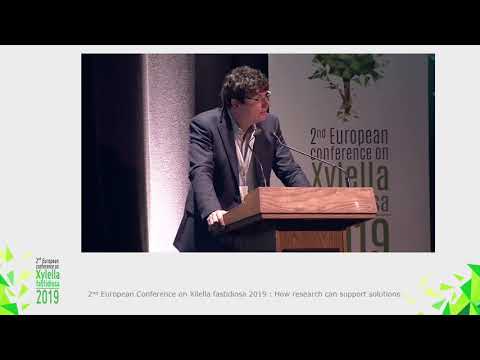
Alcuni momenti della conferenza
Documenti e presentazioni
- Opening session
- Session 1: Biology and pathogenicity I
- Landa: Understanding the potential origin and epidemiological consequences of the Spanish outbreaks caused by Xylella fastidiosa subspecies multiplex
- Saldarelli: Insights into differential responses of olive cultivars to Xylella fastidiosa infections
- De La Fuente: Extent and ecological significance of homologous recombination in Xylella fastidiosa
- Almeida: Can genome sequences tell us anything worthwhile about Xylella fastidiosa ecology?
- Session 2: Vectors I
- Rasplus: Reconstruction of the plant-vector trophic networks involved in the spread of Xylella fastidiosa through hybrid capture
- Simonetto:Mark-recapture experiments to estimate the dispersal capacity of Philaenus spumarius
- Bosco:Phenology and host-plant association of spittlebugs in Mediterranean olive groves
- Avosani:Use of vibrations to manipulate the behaviour of the meadow spittlebug Philaenus spumarius
- Session 3: Detection
- Poliakoff: Novel and high-throughput diagnostic procedures to detect Xylella fastidiosa in planta and vectors developed within POnTE project
- Dupas: New tetraplex qPCR assays for simultaneous detection and identification of Xylella fastidiosa subspecies in plant tissues
- Cole: Validation of real-time PCR assays for the specific detection of each Xylella fastidiosa sub-species
- della Coletta-Filho: A quick and efficient method for detection of Xylella fastidiosa in olive plants based on tissue-print
- Loconsole: Optimization of sampling and testing procedures for detecting Xylella fastidiosa in large lots of plants for planting and nursery stocks
- Session 4: Ecology, epidemiology and modelling
- Chapman: Developing a spatial epidemiological model to estimate Xylella fastidiosa dispersal and spread
- Gilioli: An epidemiological model for the short-range spread of Xylella fastidiosa and the assessment of eradication management measures
- Martinetti: Risk maps and risk-based surveillance for early detection of Xylella fastidiosa in continental France
- Bucci: The spreading of Xylella fastidiosa subsp. pauca among the olive orchards of Southern Italy (Apulia)
- Session 5: Vectors II
- Session 6: Risk and impact assessment
- Beck: Monitoring the impact of Xylella on Apulia’s olive orchards using Sentinel-2 satellite data and aerial photographs
- Parnell: An updated assessment of the risks to plant health posed by Xylella fastidiosa in the EU territory
- Schneider: Potential impact of Xylella fastidiosa subsp. pauca in European olives: a bio-economic analysis
- Sánchez & Mosbach-Schulz: Estimating the economic, social and environmental impacts of European priority pests: a joint project for EFSA and JRC and the case study of Xylella fastidiosa
- Colella: Living with Xylella: The dynamics of knowledges within X. fastidiosa “sociopathosystems” in Puglia and Corsica
- Session 7: Surveillance
- Mastin: Targeting surveillance for Xylella fastidiosa in Europe: an epidemiological basis
- Hornero: Spatio-temporal monitoring of Xylella fastidiosa in olive trees using radiative transfer models and Sentinel-2 images
- Lázaro Hervás: Optimization of the delimiting survey strategies for Xylella fastidiosa in the demarcated area in Alicante
- Vos: EFSA tool kit for Xylella fastidiosa risk based surveillance in the EU Member States
- Session 8: Biology and pathogenicity II
- Safady: Spatial distribution and genetic structure of Xylella fastidiosa subsp. pauca in Olive trees in Southeast Brazil
- Burbank: Cultivar susceptibility and temperature-dependent recovery of Xylella fastidiosa-infected grapevines
- Román-Écija: Phenotypic characterization of two Spanish strains of Xylella fastidiosa subsp. multiplex ST6 differing in plasmid content
- Kahn: Ancestral state reconstructions of Xylella fastidiosa-host plant relationships
- Morelejo: Rethinking the Xylella fastidiosa scenario in the Balearic Islands: what epidemiological, phylogenetic and dendrochronological data tell us
- Session 9: Sustainable control measures
- Picard: The VSPP, a voluntary certification programme to produce healthier plants for planting in the EU
- Boscia: Further acquisition on the response of a large number of olive cultivars to infections caused by Xylella fastidiosa subsp. pauca, ST53
- Dongiovanni: Strategies for reducing vector populations and transmission of Xylella fastidiosa in olive groves
- Baptista: Understanding the olive microbiome of susceptible and resistant cultivars for sustainable biocontrol
- Final Session: What achievements and new research targets for control of X. fastidiosa?
- Peeters: European Farmers’ and Agri-Cooperatives’ point of view on next research priorities for control of X. fastidiosa
- Pagès: European Nurseries’ point of view on next research priorities for control of X. fastidiosa
- Di Rubbo: Risk managers’ point of view on next research priorities for control of X. fastidiosa
- Bragard: Final conclusions
Gruppo di esperti scientifici

Esperti in valutazione del rischio da organismi nocivi alle piante, patologia vegetale...