

Episode 45 – A bug’s life: How pesticides affect wildlife
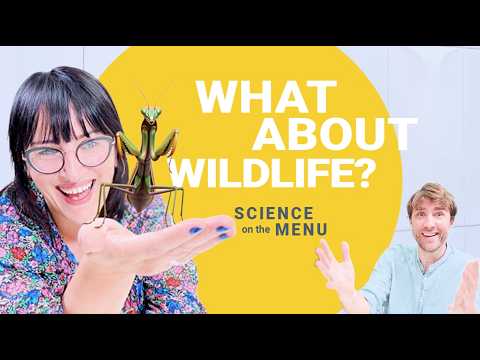
Bees, fireflies, lady birds, praying mantises and countless other creatures help keep nature in balance. But many are under pressure, and pesticides are one part of the story. In this episode, we look at how pesticides affect wildlife, from pollinators and soil organisms to birds and aquatic life. Together with EFSA expert Laura Villamar-Bouza, we explore how the environmental risks of pesticides are assessed, why biodiversity matters for farming, and whether new approaches could help protect both food production and the natural world. And along the way, we get up close and personal with a small, green and rather spiky guest!
Listen on:


00:00 – 00:23
Laura Villamar-Bouza
It’slikely a European Mantis. So it's a beneficial insect. It's quite good that you have it in your garden, and it's famous because it has this sexual cannibalism. So basically, the male is just a source of protein in that moment, so nothing personal. Okay.
00:23 - 00:50
Edward Bray
Hello, and welcome to another episode of Science on the Menu. My name is Ed Bray, and today we're talking about pesticides and the environment. How do pesticides affect our wildlife? We'll be talking about the good news, the bad news, and also what this means for us and our future on this planet. But first, our guest, Laura Villamar-Bouza. You're an expert on environmental risk assessment of pesticides. Welcome to the podcast.
00:51 - 01:15
Laura Villamar-Bouza
Thank you. Thanks for having me. It's a great pleasure.
Edward Bray
Okay, so we talked in the past on this podcast about the effects of pesticides on our health. Today we're talking about the effects on our environment. The first question is: you study something called ecotoxicology. Can you tell us what that is and how does it relate to pesticides?
01:15 – 02:07
Laura Villamar-Bouza
What we are doing in the area of ecotoxicology is trying to understand what pesticides do to these living organisms, which are not the intended targets of the pesticides. We have to address two main questions in this area. The first one is about more the environmental fate. Once you apply a pesticide, how is it transformed in the environment, and where does it go? Does it go into the water? Does it go into the sediment? How long does it stay there? And also, if it’s a degradation profile, or if it's really persistent over time. This is the first part of the environmental risk assessment, which mainly deals with environmental fate.
Then, in the second part, we try to understand the effects that the pesticide or any degradation product can have on living organisms, and also the consequences in the long term.
02:07 - 02:28
Edward Bray
Okay. And also within the food chain, I imagine as well, because if it's impacting on one part of the food chain, let's say lower down the food chain, it can then impact on mammals and birds that feed on those insects, let's say.
02:28 - 02:50
Laura Villamar-Bouza
Indeed, in the ecotoxicology part of the environmental risk assessment, we look at the complex picture.
We can have multiple organisms, and we look at all of them because, in reality, the environment is interconnected. One is the food web; another is pollination, for example, or the nutrient cycle.
Edward Bray
Actually, you've brought something with you. Could we bring that in and have a look?
Laura Villamar-Bouza
Yes, of course, of course. Here we have some cocoons of bees. Megachile rotundata. The common name is the alfalfa leaf cutting bee. Okay. To create these cocoons, this bee is going to be visiting crops, cut the leaves, roll the leaves and lay an egg in there, and put in some food provisions. In a way, these cocoons also bring in the concept of multiple exposures to the same organism. You can imagine that the bee can be exposed to a pesticide while it is flying around, but the larva can also be affected by the potential deposition of this pesticide on the leaf and throughout the developmental period.
03:27 - 03:38
Edward Bray
Okay. I understand that you brought these from home, and you have a personal interest as well as a professional interest in wildlife, correct?
03:38 – 04:12
Laura Villamar-Bouza
Well, in this case, I have these cocoons because my kids also really love them. I've been connected to this area of ecotoxicology since I was a child. I grew up on a farm, and I was always connected a little bit with this experience.
Also, my parents and my grandmother told me about fields where they found these amazing fireflies over the summer, and now you can barely see one. In a way, this drove me to the question: why is this happening? It's a recurring question for many scientists in this area who are trying to explain what is happening in the environment. We know today that pesticides are one of the contributors to this insect decline.
04:12 – 05:01
Edward Bray
Okay. So you saw, in real time, the disappearance of insects on the farm where you were living. I've also got another guest for you here, which I found in our garden yesterday. This is a praying mantis. You can see it's quite small, so I think it's a relatively young praying mantis. I don't know if it's a female or a male. Our viewers can see. What I've got here, for those listening online, I've got a praying mantis that's now standing on top of my glass, also looking at me. Tell me about this praying mantis.
05:01 - 05:40
Laura Villamar-Bouza
It's likely a European mantis. So it's a beneficial insect. It's quite good that you have it in your garden. And it's famous because it has this sexual cannibalism. So we all know that the female eats the male after the mating. But just to say that there is also good reason behind: it’s because the mantis needs a good protein source for what is coming next. So after the mating, they have to produce this ootheca with all the offspring. And, this requires a lot of energy. So basically, the male is just a source of protein in that moment so nothing personal.
05:40 – 06:13
Edward Bray
Okay, so he's doing his bit for his children at the end there as food. So I'll now see if I can get him or her back him in the jar. Thanks for joining us, little guy. Let's move on now to the risk assessment process. First, before we start on how their effects are assessed, there's a division between how pesticides are approved, and what's considered acceptable in terms of risks, and how those risks are assessed. Can you explain who's responsible for that? Because EFSA doesn't decide if a pesticide is acceptable or not for the environment, right?
06:13 - 06:34
Laura Villamar-Bouza
Yes, yes, indeed. There is a need for a clear distinction between the two roles. In EFSA, what we do is to provide scientifically based advice to the risk managers, who are the ones who will then make the decision. In a way, science informs the decision. But it does not make the decision.
06:34 - 06:48
Edward Bray
There are studies that have to be done on specific insects and on other groups of wildlife. Is that right?
06:48 - 07:15
Laura Villamar-Bouza
Yeah, that's correct. For the environmental risk assessment, we have different types of studies, which are, of course, from what we can call model species. Okay, we don't test, 100 birds, but we know that outside there we have 100 birds. We check data on birds, mammals and aquatic organisms: fish and algae as well. We have data on bees, on other non-target arthropods, and also on soil organisms, for example, soil microorganisms.
07:15 – 07:44
Edward Bray
That then goes to the decision-makers, and they have to decide what the protection level is. Is that going to be respected? Then, if yes, they're also deciding on the conditions of use, right? Because I sometimes see specific instructions on labels: "Don't use it so close to waterways," or other instructions. Yeah. So that happens after that point, right?
07:44 – 08:37
Laura Villamar-Bouza
They agree on the conditions at the level of the product assessment, and it's a great connection between the risk assessment and, let's say, what will happen later in the field. It's a connection between the scientific process and also the farmers, I would say, because all that information that you see on the label is the result of an evaluation that was done by an ecotoxicologist. For example, they may have seen that if you apply the substance during the flowering of that crop, you can have an issue with bees.
Or if you apply it close to water bodies, for example, then some residues will remain that fish, amphibians or other aquatic invertebrates may not be able to handle. All that information that you see on a label probably comes from a risk assessment.
08:37 - 09:09
Edward Bray
Okay. Let's talk at a high level about the discussion around pesticides, because we talked in positive terms about the assessment.
If I can bring in the bad news first, before the good news: the bad news is that we see declines in wildlife populations in studies everywhere, even anecdotally when you're driving along. In the past, people told me you would have many insects on your windscreen after a long journey. Now that's rarely the case. It's a sign that there are just fewer insects.
We see that decline, and we know it's multifactorial, but we also know that pesticides have a role in that.
09:09 - 09:26
Laura Villamar-Bouza
Yes, yes, we know that pesticides are also contributing to this overall decline, this overall biodiversity decline. But we know that there are other factors: habitat loss, for example. It is quite important that we manage this whole situation also with, let's say, a multifactorial solution. It's not only about pesticides, but also about other types of measures that can help to mitigate this overall biodiversity decline.
09:26 – 10:03
Edward Bray
Okay. It's also in our own interest and in farmers' interest, because there are insects that have an important pollinator role. There is also the health of soils. We often forget that there are organisms in the soil that help make it productive.
You also talked before about positive pest management, where some insects or other creatures have a role in pest management themselves. We need this wildlife around our farms as well for them to be productive, right?
10:03 - 10:33
Laura Villamar-Bouza
We also need a multifactorial solution, and this is something that is possible. We can have some natural enemies.
This concept of integrated pest management, for example. Just join both things: the chemicals and also other types of processes to handle it.
10:20 - 10:33
Edward Bray
Okay, let's shift to the good news. That's the bad news. But change is happening. Tell us some of the positive changes that we've seen in terms of pesticides and how they're regulated.
10:33 - 11:19
Laura Villamar-Bouza
We need to understand that pesticide regulation has been in place in Europe for more than 30 years. This is already something very positive, because we have seen that, in these 30 years, many substances were taken off the market, probably because of some concerns: health or environmental concerns. We are now handling pesticides that are better than the ones that we had before.
This also brings some innovation to the process: new challenges, but also some innovation. When I say "innovation", I'm referring, for example, to biopesticides. We are now seeing new types of pesticides that are expected to be less persistent in the environment, more targeted to the species that they intend to eliminate, and not affect other species.
We also have this kind of promising window ahead of us, just for this new evaluation. The pesticide, in a way, can also bring some innovation to the process.
11:33 – 11:41
Edward Bray
Okay. What about EFSA? What are we doing to help improve the system and develop it? Are we working on methodologies, for example?
11:45 – 12:36
Laura Villamar-Bouza
Yes, yes, yes. We are trying to continuously update the science behind the process.
Science, of course, is evolving, and we are trying to incorporate it into the process. We are contributing to the development of guidance documents. Whenever we have new information, we are trying to evaluate it in line with the best current state of the art. We need to consider that every piece of data that we have is already telling us a story.
What we are also trying to do in the environmental risk assessment is extrapolate this story to the real environment. As I mentioned before, this could also be complex. It could also involve some uncertainties. But I think uncertainties are part of the process: identifying these uncertainties, just to flag them.
It's not a failure; it's also about being rigorous and talking to the risk managers, who will make the decision, but with a certain level of caution.
12:36 – 12:55
Okay. We talked about what farmers can do, how they can use certain practices, and also this integrated pest management, where you can have beneficial species helping. What about us? What about me, for example? Are there things that I can also do myself?
12:55 – 14:40
Laura Villamar-Bouza
For sure. There are always things that we can do at the individual level. For example, you mentioned the labels before. I think one important message is that the labels are there for a reason. When you apply a pesticide, you need to use the dose stated on the label and not apply twice that dose, because this information was there because there was an evaluation behind it.
If you apply double, yeah, it could probably be an issue for some non-target species. This is something that we can do. What we can also do is—I don't know if you have a garden or something like that—you can always keep your backyard a little bit wild, let's say, so we have some flowers. I mean, don't continuously cut the grass.
Allow the flowers to grow, to have some parts that could help as a refuge for the little animals, such as hedgehogs, for example. You can have a small pond or something like that, just a water body. That could also be very helpful for other insects that live part of their life in the terrestrial environment and part in the water, such as dragonflies, for example.
There are, I think, many things that we can do at the individual level. Then, of course, at the farmer level or at the management level, let's say, there are also some things that we can do. For example, these kinds of buffer strips, these vegetative strips, are already creating the agricultural landscape. In that way, you also have some places as a kind of refuge for the animals.
And all these insect pollinators as well, etc. There are plenty of things that we can do to manage the risks that we identified in a responsible way.
14:46 - 15:06
Edward Bray
Okay. Thanks very much, Laura. I think my friend in here is getting restless and wants to go outside into... I think I'll release him in the garden so he has a new habitat.
We'll find out if it's a he or a she at some point. Yeah. Thanks very much, Laura. Thanks for giving us your expertise.
Thanks for joining us, for watching us. Thanks for following us here. Please tune in to our other episode on pesticides and health. But for now, that's it from all of us. Join us again sometime soon for Science on the Menu. Thank you and goodbye.
Podcast details
Host: Edward Bray, Communications Officer in the Communication Unit at EFSA
Guest: Laura Villamar-Bouza, Scientific Officer in the Environment, Plants and Ecotoxicology Unit at EFSA
Disclaimer: Views expressed by interviewees do not necessarily represent the official position of the European Food Safety Authority. All content is up to date at the time of publication.