
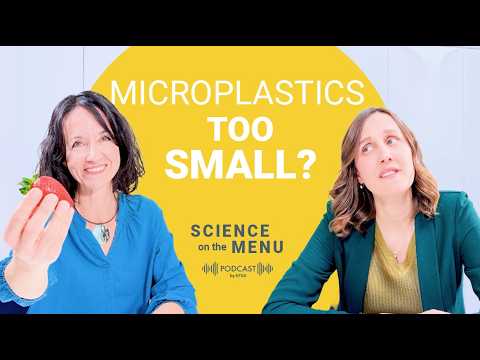
Episode 41 - Microplastics in food: What we (don’t) know
Microplastics are everywhere, from the oceans to our food, but what do we really know about their impact on our health? In this episode, we take a closer look at where microplastics come from, how they end up in food and drinking water, and what happens to them once they enter our bodies. Together with EFSA expert Elena Rovesti, we explore what science can already tell us, why so many uncertainties remain, and what research is under way to better understand the risks linked to microplastics in food.
Listen on:


00:00
Mariya Dokova
If we have to think about this box of strawberries, how do microplastics, if any, enter these strawberries? Is it through the farm they were grown on? Is it maybe through how they were transported? Or is it maybe this nice plastic packaging?
[Intro]
00:24
Mariya Dokova
Welcome back to Science on the Menu. Today we're talking about microplastics in food, a growing concern for many Europeans. In this episode we would explore what we already know about microplastics, but also many of the uncertainties that still remain. To help me unpack this quite complex topic, I'm joined today by EFSA’s expert on microplastics, Elena Rovesti. Welcome, Elena. Nice to have you on the podcast
00:50
Elena Rovesti
Thank you. Nice to be here.
00:53
Mariya
As I mentioned in the intro, microplastics can be quite a complicated subject. So, I would like us to start with something lighter, if you wish. I would like us to watch together a very short clip from a previous podcast episode we had on science communication. Very quickly, I'll just bring it on screen.
01:10
Barbara Gallani (from previous episode)
Four-year-old, little super cute boy and he says: “I’ve got a joke, can I tell you Auntie? A man goes to the fishmongers and says: I want a fish. And the fishmonger said: You want me to put it in a plastic bag? - No, thanks. The plastic is already inside it.” So, this really shows that the scientific work that we do is really relevant because, these issues are being talked about and we need to provide answers as quickly and as precisely as possible.
01:40
Mariya
You heard the voice of our guest, Barbara Gallani, who was telling us a bit of an anecdote of her very young nephew who was telling her joke about microplastics.
So, he was kind of aware of this topic. She was quite surprised. So, my first question for you, Elena, that would be, how did we get here? That microplastics is becoming such a hot topic that, you know, even if young children tell jokes about it?
02:02
Elena
I think this is not a new topic. Plastics have been something we are very aware of for a long time. In the last few years, the microplastics have become more of a concern.
In the past, we were thinking about the big plastics. So, I think we are all familiar with the wildlife, with pieces of plastic entangled in their body or having ingested so much plastic, especially in the marine environment, where they would not be able to survive and they would die. And suddenly we find all of these plastics in their stomachs.
We moved on from there, actually, we see the big plastics, but maybe the plastics that we don't see anymore are also a concern. So the research community started looking into what are the plastics that we cannot see. And suddenly they started realizing that they're there. They're in our bodies and in the environment. Until probably ten years ago, we thought that the plastic was a problem of the marine environment.
We are all aware or we have all heard about this plastic island that is moving around the ocean, but probably in the last few years, we've realized that it's not just a problem of the marine environment. Plastics are also in the terrestrial environment. They're in our soils. And therefore once we start looking for the plastics, we find them.
And that's why I think it has become more and more heard of, about the problem of microplastics in the environment. And I believe the news has also picked up on this new topic.
03:32
Mariya
Indeed. And according also to the latest Eurobarometer on food data, it's one of the top concerns for many Europeans. But how do we define microplastics?
03:53
Elena
So plastics are polymers that don't degrade. So, when we take a piece of plastic, it breaks down in the environment. If we think about the waste and how the waste behaves in the environment, they break down and they will eventually become very small. So, something that is smaller than approximately five millimetres, it's considered microplastics. So that the bigger microplastics we still see, we can see them to the naked eye.
We can find them on the beach, for example. They're quite beautiful and colourful in a way. When they become smaller and smaller, we start speaking about nano plastics. So, this definition is still not very well agreed. Some scientists prefer to speak about one micrometer, some others prefer something smaller to define or to divide and define micro and nano plastics.
But in general, when we speak about microplastics, we speak about small pieces of plastics that are generally not visible to the naked eye.
Mariya
04:58
It sounds very ominous when you think about microplastics or you read about them today, everywhere, you know, in the air and the soil and the water. Would it be correct to assume, though, that for us as humans, our main exposure to these microplastics comes from our food?
05:11
Elena
I would say yes. As you said, we find them a bit everywhere. Microplastics were found in the oceans and in the water, like surface water and soils. They are found also in the sea breeze, because they are so small and they tend to be sending to the air by the movement of the waves. There is an element of inhalation as well. And in these kinds of environments, but it is also believed that when we inhale microplastics, if they are not small enough to be absorbed, they tend to be entering our stomachs. So I would say also in that case, food is probably the main cause of exposure, obviously together with water.
So, I would say food and drinking water are the main way we get exposed to them.
06:05
Mariya
Some very vital things we all need to do. Indeed. Okay. There are many concepts, something to help me, but I hope both our listeners and viewers understand a bit better what we'll be discussing today. We have a bit of a prop here.
So for our listeners, I'm holding a plastic box of strawberries, one you can easily get in the supermarkets in Italy, where we're based. Elena, if we have to think about this box of strawberries that smell very nice, by the way, how do microplastics, if any, enter these strawberries? Is it through the farm they were grown on? Is it maybe through how they were transported? Or is it maybe this nice plastic packaging?
06:49
Elena
As you probably expect, it is a bit of everything. If we start from the plant. So, we spoke about contaminated soils, we know that micro nano plastics can be up taken by the plant. In the plant, they will be transported and can enter the fruit.
Obviously, there is also irrigation. So, if there is contamination in the irrigation water, that can also contribute to the load of microplastics in the fruit. There are some agricultural practices that we implemented to make agriculture more sustainable but actually might introduce themselves some more microplastics - if we think about the mulching, so the use of plastic sheets, maybe plastic pipes to reduce the use of water. So there are all sorts of different actions, things that we do that can contribute to increase the microplastic load.
Then when we collect the plastics, before they enter the plastic box, they can be washed and can be handled on belts. The belts are generally made of plastics. So, there's all sorts of moments where the fruit can be in contact. In terms of the food quantum material, that is a risk. But our colleagues from the Food Contact Material team, they published a recent scientific statement in which they actually didn’t identify - based on the available evidence obviously - they didn't identify a big problem, so they didn't identify a very high release of microplastics from food contact material. In a way, they also concluded that there is not enough evidence. So, they are planning to repeat this literature review in about five years. But the answer is, yeah, there are so very many different reasons why microplastics can be contained in those beautiful-looking strawberries.
08:50
Mariya
I think we have around 500g of strawberries. And at this point, do we have the knowledge to estimate the amount of microplastics that might be contained in this amount of strawberries?
09:03
Elena
Yes, we can analyze, we can quantify and identify which plastics are contained in those fruits. It is very complex and very complicated for the number of reasons that in a way we are already seeing that there are different shapes, different sizes, different substances, so the plastics can be different. So yes, it is possible to analyze and quantify. It is a very long process because we need to remove the matrix. So, we need to digest, literally digest this strawberry to be left with the plastic, and there is also the problem of comparing results. Different laboratories at this moment can provide very different results, for a number of different reasons.
Also, sometimes cross-contamination in the lab, because the equipment used in the laboratory, a lot of the equipment is made of plastic. So with the risk of by slicing a slice of strawberry on a cutting board, which is made of plastic that could cause cross-contamination in itself.
10:12
Mariya
In a box like this, can we say, okay, this amount of microplastics is too much? Are we there yet to be able to say this? What should be, let's say, the maximum amount of microplastics that is not damaging our health?
10:32
Elena
We are quite far from understanding what are the real health effects.
We don't really know if there are health effects. We know there are big differences between microplastics and nano plastics. We are expecting the smaller plastics which can enter the cells will probably cause bigger problems, but we don't really have a definitive answer. We don't have real toxicity data to allow us to conclude on that, I'm afraid.
11:02
Mariya
I just want to pick up on something you mentioned earlier, digestion. We are home. We've washed these lovely strawberries. We've eaten them. Do we know if microplastics were contained in the strawberries? Do we know what happens? Do they pass through our bodies? How does digestion affect this process? Are they absorbed?
11:24
Elena
There is evidence that shows that most of the bigger particles are excreted in the faeces, so they go through our intestine and we excrete them, which is very good news. The smaller particles, there is some evidence in vitro that they can enter the cells. And therefore, those will probably not leave our body, and this is I would say where the most of the concern of the general public starts because we speak about accumulation.
We know that something happens in the cell. We don't really know whether that is causing any maybe longer-term issues to the body.
12:02
Mariya
From what you're telling me, a common theme that I always identify is with the uncertainty around the topic. We acknowledge that there is concern, but there is also a lot of uncertainty. So why is there so much uncertainty on microplastics Elena?
12:20
Elena
It is a very complex topic because of, as we said, these different sizes, different shapes, different compounds, so, we might have different plastics. The analytical problem is still really much here with us. So, we need to harmonize analytical methods that would allow us to compare.
So, by being able to compare, we could collect all the evidence that the scientists are putting together to build the evidence and allow us to conclude if there is the need, for example, for maximum levels. So, what would be acceptable in the box of strawberries? Would these be okay for a person to eat the whole box in terms of microplastics, or would it be a risk for a child who is a lot smaller?
That is really the real problem. The analytical methods there are very complicated, especially when we speak about food. The matrix is the problem. So, the plastics are in the fruit. We need to remove the fruit to be able to see and analyze and identify the plastic. We need to do that with a digestion which is not too strong, otherwise we would melt down the plastics. So, we need to keep the plastic and remove the matrix, which is the fruit. I understand that for analyzing a sample of meat, for example, we need two weeks of preparation. So, for each of any of the samples we need two weeks of preparation that's quite a long enough time to collect data on occurrence in food. Real life data.
14:07
Mariya
It seems like the data is there or the tools, in a way, are there, but it's kind of difficult to link them to real life outcomes or long-term exposure.
14:19
Elena
Yes, exactly. Exactly. So the analytical methods would allow us to put together all the evidence and conclude, and we would be able also to derive an exposure. How much microplastics are we actually ingesting? How much stays in our body? Is that a risk or or not? Is that a problem for us or not?
14:44
Mariya
We do need clear scientific evidence. We are getting there, from what you're telling me, can you give me some examples of concrete steps that are being taken to understand the topic a bit better and to kind of counteract the negative effects of microplastics?
14:57
Elena
Yes, there is a lot of research. And I would say that the research on microplastics, macro-nano plastics in the last few years has increased exponentially. So, definitely a lot of activity. I'm thinking about the CUSP, which is a research cluster. So, this is at European level, and there is a group of various projects which are funded by the European Union.
They've actually finished the first wave of activity, and they are looking at impacts on human health of microplastics. They have also put together a roadmap and they will continue with another wave of projects to continue to study these problems. In the meantime, the European Union and the European Commission have implemented a ban. This is banning the use of certain microplastics, which were put in some products, like the microbeads for face scrub, plastic litter. This ban is continuously being implemented. So I think it came into action in 2023 for certain products, and they are slowly, implementing a ban on more and more products where the use of microplastics was unreplaceable. So, when they can replace or they're not particularly essential, let's say, they will be banned. There is also further action at European level where the idea is to reduce the unintentional release of microplastics.
This is at a higher level, but the idea is that there should be a better management of waste, and also a reduction of the release of plastic pellets. So, the plastic pellets are virgin plastic being shipped around the world, and there seem to be a really, important loss of pellets in the environment.
So, I think the idea is to start monitoring more closely what is happening with these pellets and why are they lost and can we reduce that? There's a lot of activity also at European level already. Also at a Member State level, I would say there is plenty of activity in terms of research. The different agencies are really active on the topic.
17:17
Mariya
Here at EFSA, what's keeping us, what's keeping you busy actually, regarding the topic of microplastics.
17:20
Elena
Yes, definitely. We have received a mandate from the European Parliament, which we have discussed also with the Commission, and we have been asked to assess the risk for human health, from the presence of micro-nano plastics in food in particular. This is something that will keep us busy for a couple of years. We are working with our panel on contaminants in foods and feed, with external experts and we are also involving observers from the other agencies and from the JRC. The idea is that we would like to provide some advice, on which techniques, which analytical techniques to use, to analyze, to quantify for microplastics in food.
18:09
Mariya
That's a big, big endeavour. Best of luck on this project. While all these efforts continue and we wait for them to take shape and deliver, I wanted to ask you if you can give me or our listeners and viewers some practical steps we can all take to reduce our exposure to microplastics, if we're concerned about this.
18:32
Elena
First of all, I wouldn't be concerned about consuming fresh fruit, definitely. Something that I personally think anybody can do is reduce the single use plastics. It's not very directly reducing our exposure, but it is very clearly reducing the load of plastics that enter the waste chain and potentially in the environment.
So it's a way to reduce the plastic that are being produced and released in the environment. So from my point of view, that is a quite straightforward action that anybody can take.
19:17
Mariya
Great. Thank you very much, Elena. It was a pleasure to have you. Thank you for sharing your expertise. And who knows, maybe soon you'll be on another episode to give us an update on all this amazing work we are doing here at EFSA, also together with our partners.
19:33
Elena
That would be great. Thank you.
19:34
Mariya
Thank you. Thank you very much also to our viewers and listeners for joining us for another episode. If you would like to learn more about microplastics or other scientific topic we have covered, make sure to check the previous episodes of Science on the Menu.
Make sure you follow EFSA on our social media channels and visit our website. That's all for now, and I hope to see you next time on Science on the Menu.
Podcast details
Host: Mariya Dokova, Communication Assistant in the Communication Unit at EFSA
Guest: Elena Rovesti, Scientific Officer in the Feed and Contaminants Unit at EFSA
Disclaimer: Views expressed by interviewees do not necessarily represent the official position of the European Food Safety Authority. All content is up to date at the time of publication.