
Info Session on EFSA’s 2026/2027 Funding opportunities
Summary
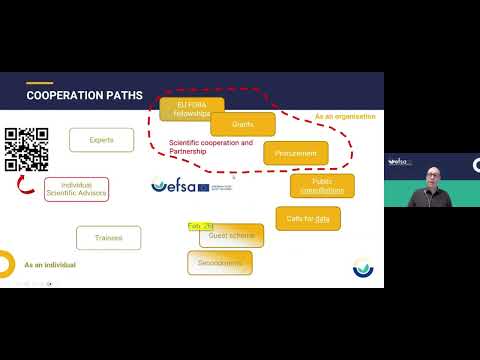
EFSA organised a 2.5-hour online event to present its framework for scientific cooperation and partnership, as well as the particular partnership opportunities (i.e., the expected calls for grants and tenders) currently included in EFSA's draft workplan for 2026/27.
Event highlights
The event was divided into two parts:
Part A: The partnership framework
- Scientific cooperation in EFSA’s 2027 Strategy
- EFSA's outsourcing tools: procurement and grant funding and administrative modalities
- An overview of the EFSA Focal Point Network and its role in fostering collaboration
Part B: Overview of partnership opportunities based on (a) recently launched calls, and (b) EFSA's draft 2026/27 workplan
Among the calls presented, those expected to be launched in 2026/27 fall into the following areas:
- Food additives and flavourings: Support to EFSA’s risk assessment
- Genetically Modified Organisms: Preparatory support on bioinformatics for the evaluation of the risk assessment of GMO dossiers
- Capacity building:
- Omics for chemical grouping
- Chemical risk assessment
- Strategies for Grouping Chemicals
- Human Biomonitoring (HBM)
- Microbiomes in microbiological and chemical risk assessment
- Adoption of metagenomics approaches for risk assessment
- Evaluation of microbiome-relevant biomarkers and microbiome metabolic capacity upon xenobiotics exposure
- Allergenicity risk assessment: Novel Strategy for Fit-For-Purpose Allergenicity Risk Assessment
- Biological Hazards: Support to EFSA in the risk assessment of alternative methods for the use and disposal of animal by-products and derived products
- Plant Health
- Generic simulation models for climate suitability analysis of new and emerging plant pests[3]
- Geospatial data tools: Hypercare, maintenance, support, and further development of the EFSA Spatially Explicit Environmental Data (SEED) platform in Databricks[4]
- Research to reduce risk assessment uncertainties on new and emerging plant pests
- Support to the detection of regulated EU plant pests[5]
- Implementation of Pest survey toolkit in EFSA Azure Cloud data lake architecture
- Support to EFSA Horizon scanning activities in Plant Health
- Food Composition Data: Maintenance and evolution of the open access European food composition database
- Food Consumption Data: Support to national dietary surveys in compliance with the EU Menu methodology
- Exposure from food supplements
- Emerging Risks identification in Botanical Food Supplements
The event was attended by approximately 200+ participants, who showed strong interest in the information presented.
Contact
Do not hesitate to write toAskEFSAfor more information.
NB: Information presented in the slides and video concerning calls that are currently in EFSA's draft work programme is subject to change. Any party interested in applying for any of the opportunities presented should consult the call text as it will be published.
[1] The call has been published and is currently open for submissions. The call text and its supporting documents, including any clarifications that have been given, are available here.
[2] The call for the fellowship cycle 2026-2027 has been published and is currently open for submission of proposals. The call text and its supporting documents, including any clarifications that have been given, are available here. The questions on the call that have been addressed during the info session will be replied to in detail, also in writing, and they will be available as clarifications on the call page. A similar call is expected in 2026 for the fellowship cycle 2027-2028.
[3] The call has been published and is currently open for submissions. The call text and its supporting documents, including any clarifications that have been given, are available here.
Agenda
| Time | Agenda point |
|---|---|
| Welcome and introduction of participants | |
| Part 1 | Scientific cooperation projects: strategy, financial & administrative modalities, support mechanism |
| Contribution of scientific cooperation projects to the mission of EFSA | |
| EFSA’s outsourcing tools: funding via procurement and grants, and administrative modalities | |
| A support mechanism for potential partners: the EFSA Focal Points Network | |
| Q&A for Part 1 | |
| Break | |
| Part 2 | Envisaged funding opportunities for 2026/27 |
| Overview of planned calls for grants and tenders for 2026/27 | |
| Q&A for Part 2 | |
| Closure of the meeting |
Documents
Video