

Episode 44 – Forever chemicals: what are the health risks of PFAS?
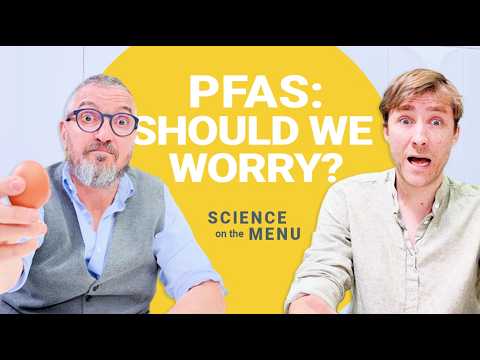
Forever chemicals are everywhere – but how worried should we be about them? In this episode, we look at the health risks from PFAS, a large group of chemicals used in everyday products, from non-stick cookware to waterproof clothing and food packaging. Together with EFSA expert Hans Steinkellner, we explore why these substances persist in the environment, how they can end up in our food, and what science tells us about their effects on human health. We also examine the challenges of studying thousands of PFAS compounds and what is being done to reduce risks and better understand their impact.
Listen on:


00:00 - 00:25
Hans Steinkellner
Just to understand that these are really monitored. Member States have an obligation to monitor them, and if they find that the PFAS values are above these maximum levels, these products are removed immediately from the market. This is the way you can assume that this egg here is safe to eat.
00:25 - 00:57
Edward Bray
Hello and welcome to another episode of Science on the Menu. My name is Ed Bray, and today we're going to be talking about PFAS. You might have heard of them as forever chemicals, persistent chemicals that you can find in many of your everyday objects like pizza boxes, your non-stick frying pan, for example. We're going to be talking about why they're there, why they can be harmful to human health and what's being done about it. And here with me to discuss this is our expert, Hans Steinkellner.
00:57 - 00:58
Hans Steinkellner
Thank you.
00:58 - 00:59
Edward Bray
Thanks a lot for joining us.
00:59 - 01:00
Hans Steinkellner
Welcome.
01:00 - 01:06
Edward Bray
First of all, can you explain to us what is PFAS? What are they?
01:06 - 01:40
Hans Steinkellner
A large group of chemicals, thousands of them. They have very strong fluorine carbon bonds. And this is a bond that is very, very difficult to break. So that means that these compounds are practically not breaking down or only after a very, very long time. They are very persistent in the environment once released, so very persistent in soil, in water. And then of course, they end up in the food and feed chain. And with that also finally in the human body where they exert adverse effects.
01:40 - 01:45
Edward Bray
Okay. And we talk about forever chemicals. Is that strictly true?
01:45 - 02:13
Hans Steinkellner
Well, this is a term that has been coined. Now that's very catchy, but I don't think it's really scientifically correct because these compounds are very persistent. Some of them really for years, some much less, but they are not forever. So, once you stop producing them or once you stop letting them out in the environment, they will go away - some sooner, some later - but they all will go away. They will not stay forever.
02:13 - 02:26
Edward Bray
Okay, I mentioned in the introduction some of the ways that PFAS is used. Can you tell us more? Why do we find PFAS in many of these everyday objects?
02:26 - 03:01
Hans Steinkellner
They are very valuable industrial chemicals. They are both grease and water repellent. So that makes them really very attractive in many applications. Think about frying pans. You don't need to add oil and everything is very easy. Probably we all have PFAS containing textiles at home. They're very, very handy. I mean, they're really water repellent in that case. And paper for baking. You mentioned pizza boxes already. And a very important application is in constituents in firefighting foams. They are really very useful. And a lot of other industrial applications where they are used.
03:01 - 03:19
Edward Bray
Okay. And yet when they get into the environment, we can see that they're very persistent. There can be a huge cost involved with cleaning that up. There's potential health risks to us as well. Was that not known when the chemicals were initially being introduced onto the market?
03:19 - 03:58
Hans Steinkellner
This is really a good point. I think not. Uh, when these chemicals have been introduced, we talk really about decades ago when you do chemical analysis in food or in water or wherever, you will only find what you look for. So, so people didn't have the standards to identify those chemicals that came with time. So this really evolved back then. It was not clear for a chemist probably looking at the structure, they could have foreseen that this is something that is not easily going away. Now that we have a much better picture. Still, we are investigating. We don't have a full picture really about the PFAS contamination in Europe. We are still working on this now.
03:58 - 04:06
Edward Bray
Okay, so we've got a picture of what they are, what the group of chemicals does. What about us? How are we exposed to these chemicals?
04:06 - 04:16
Hans Steinkellner
The main factor is really food, and to a certain amount also drinking water. But here is not a major contribution.
04:16 - 04:18
Edward Bray
Okay. What kind of foods? What are we talking about?
04:18 - 04:29
Hans Steinkellner
Typically really major contributors are eggs fish, but they can also be found in root vegetables and green vegetables and even in fruit.
04:29 - 04:31
Edward Bray
Okay. You talked about eggs, Hans.
04:31 - 04:32
Hans Steinkellner
Yes.
04:32 - 04:49
Edward Bray
And I popped to the market this morning and I found myself some eggs. Can you explain to us - so here's the egg - if I'm going to have my breakfast with this egg tomorrow, how would PFAS get inside this egg? Where does it come from?
04:49 - 04:53
Hans Steinkellner
It really comes from the chicken that eats contaminated feed.
04:53 - 04:54
Edward Bray
Okay.
04:54 - 04:57
Hans Steinkellner
The PFAS that is very stable would end up in the egg.
04:57 - 05:03
Edward Bray
Okay. And what's being done to make sure that this egg is safe for me to consume for my breakfast?
05:03 - 06:03
Hans Steinkellner
EFSA already in 2008 produced a first scientific opinion on the effects of PFAS. And they also provided a risk characterization. So we compared exposure and health effects. Then this was updated in 2018. And the latest opinion of EFSA from 2020, where we have considered the newest scientific evidence. And based on these opinions, the European Commission, together with the European Member States, have acted. They have implemented maximum levels for some of the PFAS, not all of them. For those where the amount of data was sufficient, and with those maximum levels that have been implemented, just understand that these are really monitored. Member States have an obligation to monitor them, and if they find that PFAS values are above these maximum levels, these products are removed immediately from the market. This is the way you can assume that this egg here is safe to eat.
06:03 - 06:15
Edward Bray
Okay, so I'm going to put this egg back and bring this with me. Can you be more specific on possible health effects? What are those health effects that PFAS could have on the human body?
06:15 - 07:30
Hans Steinkellner
The so-called critical effect that occurs already at very low doses in humans are immunological effects. So a reduced immune response in humans. This is an effect that has been established in two independent studies where children were investigated and where their response to vaccinations was tested. So and what was found with an increased concentration, was that their response to different vaccination types, for instance, was reduced. I'm not saying that the immunisation didn't work, but the DTaP was a bit lower. Okay. There was an effect that was measurable in two independent studies. And, this really has been identified as the critical effects in humans. We also have effects in humans that increase liver enzymes, cholesterol. And there is some evidence of a reduced birth weight, but this latter effect has to be further confirmed because the evidence was not very strong. But the immunological effects are really also backed up by animal tests. And this effect was then the basis for EFSA to set their reference point, the safe level in food.
07:30 - 07:42
Edward Bray
Okay, so this safe level is set and it means that products are tested. And if levels are found above this, does that mean there's an immediate risk if levels are found?
07:42 - 08:21
Hans Steinkellner
No, it does not mean that there are immediate risks. The thing is, it's also like that these reference points are based on the effects observed. They contain also uncertainty factors. They contain considerations to make sure that this value is really very safe. Let's say an increase would not immediately lead to the assumption that you really have a health effect. Especially also, don't forget that these are weekly intakes. And this is really set in a way so that you can consume this amount every week of your whole life and would still have not any appreciable effect on your health. We are really very safe.
08:21 - 08:37
Edward Bray
Okay, let's talk about the science and why PFAS might be challenging from a scientific perspective to study what's making it hard to understand PFAS and the exposure better.
08:37 - 10:28
Hans Steinkellner
There are several issues. There are a lot of PFAS out there. We know that, but only for very, very few do we really have sufficient toxicological data. We have set our tolerable weekly intake of the four main PFAS. Well, we know there are probably around thousands for sure, thousands out there. And from them we know roughly nothing. So we had to make a lot of assumptions. But we cannot invent data that are not there. And the second thing is with regard to exposure, also here we have the same problem. The data that we have on PFAS in food and feed are limited only to those PFAS that we are actually looking for, that we know that they are there in order to rectify this. Also, the European Commission, in a response to the EFSA opinion, has implemented now a monitoring programme in which European Member States are to monitor PFAS and to send all those data to EFSA. So this programme has ended last year. Now EFSA is collecting all that data and this will really help us to, let's say, to have a much better picture about additional PFAS available, how they are distributed in which food commodities and also the distribution within Europe. So it will help us to have a more refined risk assessment. There is still always more to learn, always more. There are also toxicological investigations ongoing at this moment on instigation of EFSA. So we have asked for a study that will help us to understand the relative potency of the different PFAS. Okay. For the moment we have no data. We assume they all have the same potency. And this data will be available next year.
10:28 - 10:29
Edward Bray
Okay.
10:29 - 10:37
Hans Steinkellner
So there is a lot of research ongoing on collaborations, monitoring, testing and so forth.
10:37 - 10:50
Edward Bray
Okay. A simple question: Wouldn't it be an idea just simply to blanket ban all PFAS substances? If we know there are harmful effects, we know that there's a lot of cost in cleaning up in the environment. Couldn't you just ban them?
10:50 - 11:30
Hans Steinkellner
The answer is you could. Unlike some heavy metals like arsenic that are naturally in the environment, these are compounds that are man-made and man can also not make them again. We know it will not go overnight. It will take quite a while until they're all gone. The European Chemicals Agency, with which we are really working closely together, has proposed a ban for PFAS. This is now ongoing. We are not involved in those discussions. Just to say also that a lot of PFAS have already been banned previously from some applications. Replacements will be found and the end of the story will be that it will not be produced anymore.
11:30 - 11:47
Edward Bray
Okay, but then the story will continue because these were chemicals that had a certain use. The question then is: is there an easy replacement and will that replacement be safer than what we have currently? Is that a fair question to be asking?
11:47 - 12:09
Hans Steinkellner
This is a fair question to ask, and I think we're very much alerted. In the past, there have been the so-called regrettable replacements. We got away with one compound that we knew that was bad, replacing it with another, just to find out with more science that they are not ideal and have adverse effects. So I think all the players in this whole field are very much aware to make the right replacements.
12:09 - 12:29
Edward Bray
Okay. There's another element that we haven't discussed, and that's the authorities at national level, what they're doing to monitor also to audit and check on areas around companies - monitoring soil, water samples, etcetera, to see where possible PFAS contamination is.
12:29 - 13:00
Hans Steinkellner
Yes, I fully agree and probably from me, my perspective here is the more wide European perspective with the Commission. But of course, the groundwork, the real work is done by the Member State authorities. I mean, for sure that they really have to implement all these measures, and they really also have to act on local contaminations and take action on that. So EFSA has no say in this. We are providing the scientific background. There it ends. But the actionis then taken really by Member State authorities.
13:00 - 13:30
Edward Bray
Okay. Well, we'll follow the political discussions around the restrictions and see where those end up. Thank you very much, Hans, for joining us and explaining all of this. Thank you very much to everyone for listening and watching Science on the Menu. Please join us again next time for our next episode. But for now, that's it from us. Thank you and goodbye.
Podcast details
Host: Edward Bray, Communications Officer in the Communication Unit at EFSA
Guest: Hans Steinkellner, Scientific Officer in the Contaminants Team at EFSA
Disclaimer: Views expressed by interviewees do not necessarily represent the official position of the European Food Safety Authority. All content is up to date at the time of publication.