

Episode 42 – Pesticides: the good, the bad and the ugly
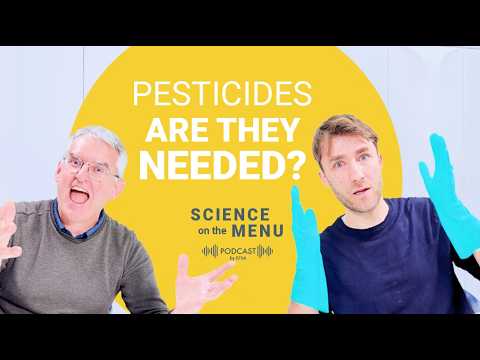
Why are pesticides used and could society do without them? In this episode, we trace the story of agriculture, from its origins to modern day. We meet familiar enemies – pests and diseases – and explore how chemicals are used to control them and keep plants healthy. And we look at how traces can end up in our food - and environment - and what it means for our health and wildlife. Together with EFSA expert Tobin Robinson, we discuss the risks, the science, and the alternatives, from traditional methods to new approaches. And we get up close with an example: the ingredients of an organic pesticide used to protect peaches.
Listen on:


00:00 – 00:08
Edward Bray
I didn't mention this, Tobin, but we've got another guest, actually, today on the podcast. He's small.
00:08 - 00:10
Tobin Robinson
I know, he's fluffy.
00:10 - 00:31
Edward Bray
He looks quite cute, but he's not actually, he's a killer. I wanted to hear from you an example of some pests out there that cause severe damage to crops.
00:31 - 00:55
Edward Bray
Hello, and welcome to Science on the Menu. My name is Ed Bray, and today we're talking about pesticides. What are they? What's in them? Are we at risk? And what are some of the alternatives? Here to discuss this with me is our expert Tobin Robinson, head of unit for plants, environment and eco toxicology. Welcome to the podcast, Tobin.
00:55:08 - 00:57
Tobin Robinson
Thank you. And happy to be here.
00:57 - 01:11
Edward Bray
And to unravel what is often a complicated and very emotive topic, which is pesticides. First question. Let's start with the why. Why do farmers and homeowners, gardeners, why do they use pesticides?
01:11 - 01:40
Tobin Robinson
Well, the answer is kind of in the name of pesticides. So these are chemicals that are designed, that are chosen to have an effect on, pests and diseases as well. So they're a means for controlling insects and similar stuff that you find eating your plants. That's the simple answer if you like. That's what the pesticides are hopefully doing when you're putting them on your plants.
01:40 - 02:07
Tobin Robinson
The bigger question is, why do we need them in modern agriculture? And really here, I guess the key is modern agriculture. So pesticides, as we think of them today, really have a history going back to the 60s and 70s when we had the chemical revolution, which is the introduction of chemicals, particularly into agricultural industry.
02:07 - 02:19
Tobin Robinson
So both in terms of artificial fertilizers to keep soils productive, but also as ways of controlling pests and diseases in intensive agriculture.
02:19 - 02:32
Edward Bray
But presumably throughout history, when mankind started the process of organized agriculture, pests, weather were always a problem. So they've always been dealing with those issues, right?
02:33 - 02:55
Tobin Robinson
Yeah, absolutely. I mean, the history of agriculture goes back about 11,000 years. So, you know, starting in the Middle East, in the Fertile Crescent, you know, what today is Iraq. And it started just coming out of the last ice age, in fact, and took about 2000 years to get from there to Europe, and to Europe in the South, East.
02:55 - 03:29
Tobin Robinson
So, around Greece, that kind of area and then takes another 3000 years, 3000 years to spread to all of the corners of Europe. So it's been something that humans have been doing for quite a while. And at its start, it wasn't necessarily an obvious thing in that, you see, in the early days of agriculture, ancient humans switching between agriculture and hunter gathering, depending upon the climate, the situation.
03:29 - 03:34
Tobin Robinson
So agriculture wasn't always the best option. It was sometimes the better option.
03:34 - 03:45
Edward Bray
And then the revolution you're talking about is in rapidly increasing productivity of farms using, using often chemicals.
03:45 - 04:14
Tobin Robinson
So, yes, jumping to modern times, well, what we saw with the introduction of chemicals was a big increase in productivity and reliable productivity, which was kind of important at that time to help feed a rapidly increasing human population. And that is the sort of agriculture that we have today, based on the tools that we have, the chemical tools that we have both for soil fertility, for controlling pests and diseases.
04:14 - 04:20
Tobin Robinson
So that the way that we do agriculture is very much integrated with the tools that are available.
04:20 - 04:33
Edward Bray
When I think of my background and where I grew up, my parents are really keen gardeners. At home they have a vegetable patch, and I've a memory of them going out with a torch at night looking for snails and slugs.
04:33 - 04:34
Tobin Robinson
Yeah, I've done that too.
04:34 - 04:37
Edward Bray
You've done that as well. And what were your methods?
04:37 - 04:46
Tobin Robinson
I don't know if there's related data coming from the UK originally, but beer traps are a very well known way of trapping slugs and snails.
04:47 - 04:55
Edward Bray
Right? So, as an example, the homeowners who are growing their own vegetables are also dealing with the same issue of pests and how they can manage them.
04:55 - 04:56
Tobin Robinson
Absolutely. Yeah.
04:57 - 05:19
Edward Bray
So we talked a bit about where agriculture, where the modern way of farming comes from. And we'll move on also later to some of the alternatives going forward to chemicals. But I went to a store yesterday and I thought it'd be interesting to show an example. So this is a fungicide that I picked up from a garden store.
05:19 - 05:46
Edward Bray
And it's an organic fungicide specifically for peaches to tackle a specific fungus. Can you tell us what would be in here? You wouldn't know exactly. I've decanted this into a special jar to show it more easily. It would come obviously in a special container. So tell us what's in there. Then we'll move on to some of the protection that is required for using it.
05:46 - 06:14
Tobin Robinson
When we talk about pesticides, we’re actually talking about two major categories of stuff that's in there, which maybe is not quite so obvious. So part of it - what we would normally think of as pesticides - are chemicals applied to plants to protect against a pest or diseases. Alsoactually in the official definition of pesticides, we also have things called biocides which are used in different situations for particularly, microorganisms.
06:14 - 06:40
Tobin Robinson
But today we're talking about how we would normally understand pesticides as, you know, as normal consumers, you know, stuff applied to plants. What you would normally expect to find firstly in your pesticide is what we call the active substance. So this is usually one or more chemicals that are specifically chosen because of the effect that they're going to have on a pest or a disease.
06:40 - 07:02
Tobin Robinson
That's the chemical that does the work in your pesticide. So there will be that in there. Then there'll be a whole bunch of things which are more, if you like, technical in nature. So you'll have the carrier, the solvent, which is there. So it could be water. It could be something else which is there to, to help, dissolve, to carry the active ingredient that is there.
07:02 - 07:35
Tobin Robinson
And then there'll be a few other sorts of technical things, like preservatives, to make sure that it's it has a reasonable shelf life, after it's been prepared. Surfactants which are there to help, spread the pesticide across the surface to make sure it doesn't just sit there in discreet little bubbles. And then the more interesting components in addition to the active substance, we could have things called safeners in there.
07:35 - 07:59
Tobin Robinson
And these are chemicals that are added to help protect the plant that the pesticides are being sprayed onto. Okay. And then the final one, synergists are a bit more complicated. So these are chemicals that in themselves, they don't actually have an action against pests or disease. But when combined with the active substance, they increase the efficacy of the active substance.
07:59 - 08:09
Edward Bray
Okay. So basically a complex mix of substances together. This one had an organic label. So what does that mean?
08:09 - 08:47
Tobin Robinson
It means that the active substance in there is not going to be one individual chemical, most likely, though there certainly are exceptions to that. But typically what you're going to find in there is one of a number of substances that are defined for organic use by European legislation. And these are often quite traditional products, things like copper sulfate, for example, may come in there or they may be, products, coming from plants or plant extracts that are being used because they're known to have an effect on certain diseases.
08:47 - 09:11
Edward Bray
Okay. So this is for peaches. And hopefully with this the fungus would be treated. And the peach that is grown would be edible. At the end of that we've talked about what's in there. Let's talk about someone using it. And the protection that would be required and how different people can be exposed to pesticide. So I showed these gloves.
09:11 - 09:13
Edward Bray
Tell us first about the user of the pesticide.
09:13 - 09:40
Tobin Robinson
Yeah. When we talk about exposure to pesticides. Yeah, absolutely. As you indicated there's kind of two main categories that we're looking at. So people eating the final product. Yeah. And people using the pesticides in in fields or in the home. So farmers and but we'll also say people using pesticides at home. Yeah. And for those it depends on, how the pesticide is being applied.
09:40 - 09:48
Tobin Robinson
Of course. So in the home context, generally, what you have to be careful of is not getting the stuff on your skin.
09:48 - 09:49
Edward Bray
Yeah. And that's where these come in.
09:49 - 10:14
Tobin Robinson
So that's why the green gloves. Gloves are a good idea. Yeah. Yeah absolutely. For people in more professional situations so farmers applying pesticides to fields then in addition to having protection for the skin then generally it will be advised to have also respiratory protection so they could be wearing respirators as well and protection for the eyes too.
10:14 - 10:15
Tobin Robinson
So some sort of goggles.
10:15 - 10:30
Edward Bray
Okay. Let’s come back to people. There's a lot of concern out there among people, about pesticide residues and the traces that could be on food. A simple question, but maybe it's a complicated one: Are people at risk?
10:31 - 10:52
Tobin Robinson
The safety assessment of the use of pesticides is focused on what happens to the pesticide after it's been put on the plant. One would hope that the majority of it is going to stay on the plants. Some of it will inevitably get washed off by rain, for example, into soil, and then from soil, maybe find its way into groundwater.
10:52 - 11:14
Tobin Robinson
And that is also part of the assessment that we do to see, what is the fate of the pesticide after it's put on the plant. So to understand exactly where it's going to go, where it's going to end up, what it's going to do when it's time, particularly, how long it's going to last as a chemical because it will get, broken down some of them very quickly, some of them.
11:14 - 11:24
Edward Bray
And so and this is what your team, are doing when they're doing the risk assessment of the chemicals, correct?
11:24 - 11:43
Tobin Robinson
Yes, this is part of it. Yes, indeed. And then the other part that is of course, of great interest to consumers is okay. And then the stuff that stays on the plant, what happens to that. And there again, what we look at is what it's doing there.
11:43 - 12:04
Tobin Robinson
Is it just sitting maybe on the leaves or is it getting taken up into the plant and therefore getting integrated into our potential fruit and vegetables? And again, to understand, you know, other chemicals themselves being modified in any way when that's happening, you know, what kind of levels would one expect? Would one expect this to happen at all?
12:04 - 12:16
Tobin Robinson
And this all contributes to calculation of the sorts of residues that one could expect to find in products on supermarket shelves.
12:17 - 12:28
Edward Bray
Okay. And in terms of regulation, how is that regulated to ensure that the we consumers are not exposed to levels that can be harmful.
12:29 - 12:50
Tobin Robinson
So what we do is we take a number of examples of expected uses. So how this product is supposed to be used in the field by the farmer, we do the calculations. And what that would mean in terms of what residue that we would expect to find on a product on the shelf. So there's a lot of parts to what's going on there.
12:50 - 13:24
Tobin Robinson
Yeah. Including, you know, the time between application to a crop and when it's actually being harvested. And that's a very important period of time, you know, potential washing of the crop as well to, to remove, some residues from the crop. And we compare that. So that gives us a figure of what we would expect to find in a final product with our calculation on the toxicity of the product itself.
13:24 - 13:48
Tobin Robinson
Okay. And with that, we will we will come up with a value that is indicative of what would be the maximum value that you could eat that would not cause you any harm. And this is modified, of course, by the kind of diets that people eat. So, you know, eating one apple once a year may be normal in some places of Europe, as in other places, maybe an apple a day.
13:48 - 14:10
Tobin Robinson
And, we will take that into consideration. And in particular, in the pesticide area, the responsibility isn't only with us, it's also with the member states. And they will be very much adapting these figures to local diets to ensure that people's exposure remains well below any danger level.
14:10 - 14:16
Edward Bray
Right. And these are the maximum residue levels that are set based on health guidance values.
14:16 - 14:17
Tobin Robinson
Absolutely. Yeah.
14:18 - 14:27
Edward Bray
Okay. I didn't mention this Tobin, but we've got another guest actually today on the podcast. He's small.
14:27 - 14:29
Tobin Robinson
I know he's fluffy.
14:29 - 14:44
Edward Bray
He looks quite cute, but he's not actually, he's a killer. I wanted to hear from you. An example of some pests out there that have caused severe damage to crops.
14:44 - 15:15
Tobin Robinson
So the farmers are having to battle against many pests and diseases. It's, you know, normal if you like, daily work of the farmers. It's complicated these days. More so than in the past. Probably by two principal things. So, one of them is climate change is a very real thing. And something that, farmers, I'm sure can share much experience with the impacts of climate change, which they are already seeing.
15:15 - 15:43
Tobin Robinson
The other aspect is, internationalization of, well, everything, not just trade of agricultural products, but also movement of people and products that are unrelated to agriculture. And there from a personal experience, yeah, I can see how easy it is for pests to move around through the activities of humans in North Italy. In fact, across quite a broad area of Europe.
15:43 - 16:04
Tobin Robinson
We have an invasive, bug, called the marmorated stinkbug. If you live in, in North Italy, you'll be very familiar with it. I know whenever you open your windows, you have a shower that will fall down. Very annoying. I remember very well, one time on our mission to Brussels, I opened my suitcase and out jumped a marmorated stink bug.
16:04 - 16:19
Tobin Robinson
Right? Just like that. So, hitching a ride with me, in a flight. So this is within Europe, which is maybe a little less concerning, but one could imagine easily international travel of pests like this.
16:19 - 16:34
Edward Bray
Yeah. So you're saying that it's not only farmers and, gardeners who have a responsibility when it comes to tackling pest. It's also us, because we can worsen the situation by bringing pests with us by mistake. If we bring a plant across the border.
16:34 - 16:58
Tobin Robinson
So, you know, it can happen very innocently like that, but also maybe a little less innocently by bringing back plants and pieces of plants, seeds, for example, from abroad, particularly from outside of Europe into Europe, you can accidentally be bringing into Europe pests and diseases which you may not see. You know, the plants could well look very healthy.
16:58 - 17:09
Tobin Robinson
Seeds that you buy could look healthy, but they could be harboring spores from fungi and bacteria and then causing a serious disease in European crops.
17:09 - 17:34
Edward Bray
Okay. So we've had our guest pesty. I'm going to throw him back. We've touched there on some of the things, the non-chemical things that people can do. So, for example, limiting the possible spread of pests is already one. But a big question is could we do farming without these chemicals? What are some of the alternatives going forward?
17:34 - 18:00
Tobin Robinson
It's very much the burning question of the day. In Europe. We have, a very strong intention, led by the European Commission, to reduce the use of chemical pesticides. And there the Commission has set an ambition for Europe by 2030 to reduce by 50% the use of pesticides and in particular to, to reduce by 50% the use of the most hazardous pesticide.
18:00 -18:32
Tobin Robinson
So this is clearly the direction of, of travel of European agriculture. Reduce the use of pesticides. You know, farmers aren’t using pesticides just for the fun. I mean, you know, pesticides cost a lot of money to use them. And, you know, it's always, a thought through decision by a farmer to use a pesticide. And, you know, if we can provide them with alternatives to chemical pesticides, I see no barrier for them to use them.
18:32 - 19:02
Tobin Robinson
It's all part of what we call integrated pest management. So this is using, you know, whatever tools you have available to control pests and diseases. So it could be things like you know, simple traditional practices like crop rotation can be a good way to avoid building up, high densities of pests and diseases. These sorts of things, combined with hopefully modest pesticide use, gives the farmer the opportunity to control pests and diseases.
19:02 - 19:30
Tobin Robinson
Okay. Super important. Because, you know, our farmers are there producing the food that we eat. Whether the farm is producing food, they're going to be very many of us around. So we, you know, the work that they do is super important. We also have to think that the level of production that we have achieved in Europe, but not only in Europe, helps ensure that we have food on our shelves.
19:30 - 19:53
Tobin Robinson
Yeah, food on our shelves at a reasonable price. Yeah. Of a good quality. And that's available all year round. That's available. We can only do that by the complex and integrated agriculture system that we have. Yeah. If we just take pesticides out of that then the whole thing kind of falls down at the moment. So we need to move to a different way of doing agriculture.
19:53 - 20:01
Tobin Robinson
That is less reliant on pesticides. Yeah. To achieve the same level of productivity. And that's the difficult one.
20:01 -20:06
Edward Bray
Could there be some technological, innovations that could come in, robots?
20:06 - 20:36
Tobin Robinson
There's all kinds of interesting stuff going on at the moment. And in general we stick it under the label of precision agriculture. Sure. But it's a little bit broader than that. But this is, looking at things like using robots to assist with either a more precise application of pesticides. So if you imagine a large field in which you just have a few spots of disease starting in there, just apply pesticides to those few spots rather than spraying the whole field.
20:36 - 21:11
Tobin Robinson
Then you've reduced massively the application of pesticides across agriculture. Okay. That's a simple one. Another one we're looking at which is fantastic if you get a chance to see it in operation is using robots to weed in fields. So to remove unwanted plants mechanically. So you have a little robot going around weeding a field. Really good. Something that, you know, from, if you wanted to do that using people, it would be super, super expensive to do it.
21:11 - 21:29
Tobin Robinson
You know, which makes the food itself super expensive. And so, yeah, not really a commercial option, viable commercial option. But by using robots it can reduce the cost of mechanical removal of weeds. And then that becomes, you know, an alternative to using pesticides.
21:29 - 21:33
Edward Bray
Okay. And this goes both for conventional and organic agriculture as well.
21:33 - 21:34
Tobin Robinson
Yeah. Absolutely.
21:34 - 22:01
Edward Bray
Okay. So there's hope for our peach grower. Yeah. So maybe you can do without the gloves and still manage to tackle this fungus. Okay. Well, thanks very much Tobin. You've taken us from the beginning of agriculture to maybe the future. Thanks very much for joining us. Thanks for watching us again on Science on the Menu. Subscribe to our channel for more episodes and see you next time on Science on the Menu.
22:01 - 22:23
Edward Bray
Thank you and goodbye.
Podcast details
Host: Edward Bray, Communications Officer in the Communication Unit at EFSA
Guest: Tobin Robinson, Head of the EFSA Unit on Environment, Plants and Ecotoxicology
Disclaimer: Views expressed by interviewees do not necessarily represent the official position of the European Food Safety Authority. All content is up to date at the time of publication.