

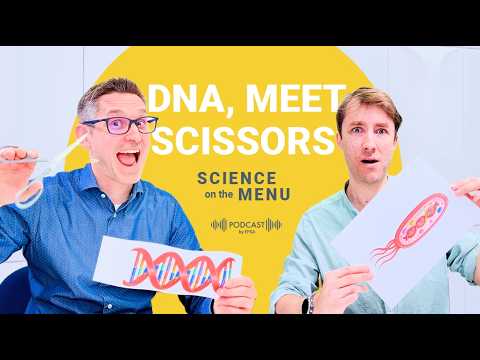
Episode 43 – Genetics in the field: how molecular scissors are redefining crops
For millennia, humans have selected and improved plants, helping us grow crops that are more productive, resilient and nutritious. But new genetic tools could completely redefine agriculture once more. In this episode, we explore how today’s breeders use tools like “molecular scissors” to edit plant genes more quickly and precisely than ever before. Together with EFSA expert Tommaso Raffaello, we trace the story behind gene editing, unravel the science and safety of new genomic techniques and discover what these advances could mean for the future of food and farming in Europe.
Listen on:


00:00 - 00:38
Tommaso Raffaello
So, what do you want to do? You want to shut down, switch off, or as we say in molecular biology, to knock out that gene. And how you do? You do it with new genomic techniques. The most famous is the Crispr Cas9 approach, which are called molecular scissors. So, they are essentially very tiny scissors. We can say that are able to cut the DNA in a very targeted way, in a very specific way, and you decide where you want to cut.
00:38 - 01:01
Edward Bray
Hello and welcome to another episode of Science on the Menu. My name's Ed Bray. People tend to freak out when they hear the term GMO, genetically modified organism. But what actually are they? And why do we have them in agriculture? And what about the new genomic techniques that we see today? How do they differ? We're going to be talking about all of this.
01:01 - 01:25
Edward Bray
We're going to learn together everything that there is to know about GMO. And here to discuss this is our guest, and expert Tommaso Raffaello. Thanks for joining us, Tommaso. Thanks to you. Big topic Tommaso. We're going to go deep into genetics. We're going to find out the situation in Europe and the rest of the world. And for a starting point, let's start with Europe, the situation here.
01:25 - 01:48
Edward Bray
Simple question. If I was to go into a supermarket here, what GMO products would I find?
01:48 - 02:15
Tommaso Raffaello
You are not going to find pretty much anything here in the supermarket which is related to GMO. Okay, for sure you're not going to find the food like vegetable and fruits. You know, the piles of vegetable and fruits that you see at the supermarket?
Well, none of them are actually GMOs, so I would say a bit all around Europe. It's very difficult to find products that are labelled actually as GMO or which are derived from GMOs.
Edward Bray
And I would know that because GMO products have to be labelled in Europe. Correct?
02:15 - 02:44
Tommaso Raffaello
Absolutely, yes. Products which are containing, consisting or derived from GMO must be labelled in Europe, if the content is more than 0.9%. So there must be a clear label on the product for GMOs.
Edward Bray
Why is that?
Tommaso Raffaello
Because GMOs in Europe, they are regulated. You must have according to the European law, traceability. So traceability, labelling, are two very important aspects of the GMO regulation in the European Union.
02:44 - 03:10
Edward Bray
Let's have a bit of history. Why do we have GMOs? What was the reasoning behind and how did that start?
03:10 - 03:38
Tommaso Raffaello
They are essentially a response to a need. For example, if we talk about plants, in agriculture, the need to create essentially varieties which have specific agronomic, traits which are very important for the breeders and the consumers.
For example, if we talk about plants, because in Europe essentially all products that have been authorized so far are genetically modified plants. So let's take an example. So you have a specific crop, for example a maize. You may want to create a variety of maize which is resistant to pests, for example insects. So you can do it via traditional methods like crossing for example.
03:38 - 04:18
Tommaso Raffaello
But the GMO technology would allow you to achieve that result, meaning tolerance or resistance to insects, in a much faster way. So creating a GMO will allow you to speed up a little bit, where sometimes a lot, the development of these varieties, if we are talking about plants, with very important agronomic traits.
Edward Bray
So you said that we don't have any products, like food products, on our shelves, but you mentioned the maize there, and there is one crop that is cultivated in Europe, and it is one of the maize types that you just described.
04:18 - 04:44
Tommaso Raffaello
Absolutely. The only cultivated GM crop in Europe is actually maize, which is called MON 810, which is a maize that has been authorized at the end of the 90s. It has a very specific trait, which is insect resistance. And the main areas where this maize is cultivated, are essentially in Spain, and a little bit also in Portugal.
04:44 - 05:07
Tommaso Raffaello
But this is the only genetically modified crop that is currently cultivated in Europe.
Edward Bray
And it's grown as feed for animals as most of the GM crops around the world?
05:07 - 05:39
Tommaso Raffaello
We have to say that the application that we receive in EFSA and products that have to be risk assessed are essentially for food and feed.
But practically speaking, in Europe, most of, if not all the genetically modified material from plants, from crops which are imported, are used essentially for feed.
Edward Bray
And here we're talking about soybean. You mentioned maize. What other crops and which areas of the world are we talking about?
Tommaso Raffaello
North America so US, Canada, South America like Brazil, Argentina, Chile, for example, India, if we go to Asia, China, Australia.
05:39 - 06:06
Tommaso Raffaello
So in these countries, a lot of genetically modified crops are currently cultivated. So the situation is very different compared to the European Union. There GMOs are not just cultivated but also used quite consistently as food and feed.
Edward Bray
Okay. What kind of foods?
Tommaso Raffaello
They are part of for example of processed food products derived from maize like maize sirup, for example, or starch.
06:06 - 06:30
Tommaso Raffaello
Cotton - there is genetically modified cotton to be resistant to insects. In fact, we have usually products derived from soybean like oil, for example. So these are essentially most of the products that are on the market.
Edward Bray
So I might be wearing GMOs but not eating them.
Tommaso Raffaello
Absolutely. Yes. What we are talking about here today is the use of genetically modified crops in food and feed.
Edward Bray
And our animals are eating them as feed in Europe.
06:30 - 06:58
Tommaso Raffaello
If you go to the supermarket, you will see that they are not genetically modified maize, because of consumer perception and also because of how the European regulation system is made.
06:58 - 07:28
Edward Bray
Okay, I can confirm this, Tommaso, because this morning before we filmed this podcast, I went to the supermarket and I looked everywhere.
So I looked through all the shelves. I looked on all the labels and I couldn't find anything. The only thing I could find actually was this, which doesn't have a GMO label. It's a sesame seed paste for tahini. It has a non-GMO label.
Tommaso Raffaello
Exactly. So it's easier to find the non-GMO labels in the products on the supermarket than to find the label related to the GMO content of that product.
07:28 - 07:51
Tommaso Raffaello
It's a combination of multiple reasons for this. Probably the most important are consumer perception in Europe and the market. In Europe it is a bit easier to sell a product which are labelled as non-GMO than products that would contain actually, genetically modified product in the food.
Edward Bray
Okay. So we've talked about the situation in Europe. Where can we find them? If we can, where are they, etcetera?
07:51 - 08:13
Edward Bray
Let's talk about what the technique actually is. GMOs - you said it dates quite a while back now, to the 80s even, around that time. What about the new genomic techniques that we see today and that have advanced since then, and how do they differ? Can you explain that to us?
08:13 - 08:43
Tommaso Raffaello
Charpentier and Doudna published the first evidence that you can use some tools, part of bacteria, immune system, reprogramme them so that these tools can be used to modify the genetic material of an organism in a very targeted and specific way. So 2012 was essentially the year where this was demonstrated by these two scientists.
08:43 - 09:33
Tommaso Raffaello
And after that we have, I would say, witnessed an explosion of the use of these technologies in molecular biology, applied to many different organisms from bacteria themselves, but also, of course, to plants, animals, fungi, and so many, many different, organisms. And this discovery was so important that it led to winning the Nobel Prize for these two ladies in 2020 for chemistry. If you consider that they are very young researchers and very few years from their discovery to the awarding of the Nobel Prize, you can understand how big was and is, of course, the impact of these technologies in the molecular biology and how we can really now modify an organism in a very specific and targeted way.
09:33 - 10:04
Edward Bray
And essentially they found a naturally occurring method for editing DNA. And they found that this could then be transferred to other organisms.
Tommaso Raffaello
Correct. So what they did was essentially to exploit something that as we said is naturally occurring in bacteria. It's actually part of the immune system, adaptive immune system in bacteria.
10:04 - 10:35
Tommaso Raffaello
They took these components and they found a very clever way to adapt it to our need in molecular biology, which is, as we say, to be able to target a very specific region, very specific site, in the genome of the organism, because so far, the way we were developing GMOs was essentially very untargeted, if you want.
10:35 - 10:59
Tommaso Raffaello
I brought some material that maybe I can very simply try to explain the main difference between conventional GMOs and plants obtained by these new genomic techniques that were developed since 2012, essentially.
Edward Bray
Let's go Tommaso, I see you've got some scissors here.
10:59 - 11:32
Tommaso Raffaello
Yes. So let's assume that you have a plant, here. And this plant is threatened by an insect, a pest, let's say. So you want to create a plant. So, to modify genetically this plant to make it resistant to insects. So you have your plant and you have the genome of the plant. So the genetic material of the plant. Well, let's assume that you did a lot of research and then, you know, that there is a bacterium and which has its genetic material, of course.
11:32 - 12:09
Tommaso Raffaello
And inside that genetic material there is a gene that could potentially protect the plant from the insect. What you do in conventional, let's say traditional GMO? You take the genome of the bacterium, and what you do - now, I need to cut it out in a very non-targeted way, let's say - I isolate from the genome of that bacterium the gene that I'm interested in.
12:09 - 12:41
Tommaso Raffaello
And now you want to move this gene to the plant genome. So how you do? You modify the genome of the plant. And you create essentially, again, a cut. Which is not again, precise. So as you can see here, you cut it, and then you insert.
12:41 - 12:50
Edward Bray
Okay, I see with some sellotape you're attaching it.
12:50 - 13:22
Tommaso Raffaello
So now let's see if you can see it. So now you have the genome of the plant which is the blue one, let's say, which contains the gene, so a specific DNA fragment from the bacterium that you see here in red. So now you can regrow the plant like this. And then this plant will be resistant to insects because this gene will protect the plant from the insect attacks.
13:22 - 13:51
Tommaso Raffaello
As you can see here, the borders are not, super precise, I would say, because usually what happens is, like this gene is inserted in a very random place in the genome. This is the conventional GMO - and also the borders sometimes are not so precise, meaning that when the plant regenerates and repairs the DNA, it might insert some errors, let's say, on both sides.
13:51 - 14:24
Tommaso Raffaello
So you're having an insertion of a bacterial gene within the genome of the plant. This is categorized as GMO in the European Union. Why? Because the definition of GMO in the European Union is that you modify the genetic material of an organism like a plant, in a way that it does not happen naturally. So this cannot happen in nature because obviously a bacterium and a plant cannot mate.
14:24 - 14:52
Tommaso Raffaello
So they cannot transfer genetic material between each other. So this is essentially the conventional GMO. And, we have received in EFSA hundreds of applications in which this gene might confer insect resistance, herbicide tolerance. You can also alter, for example, fatty acid in the metabolism for the plant to produce more balanced, let's say, fatty acid content.
14:52 - 15:20
Tommaso Raffaello
What happened from 2012 when the new genomic techniques were described, in literature or, for the first time in a very, in a very precise way. So let's assume that you have exactly the same example. So you have a plant and you want to modify that plant to make it resistant to insects. The same principle. But now, you know, and I'm going to take another example here.
15:20 - 15:39
Tommaso Raffaello
So you have the genome of the plant. Yeah. Now, you know that in the genome of the plant there is a gene like here, for example, which makes the plant susceptible to those insects. Okay. Sothe end result is going to be the same. You just want to create a variety of plant which is resistant to insects.
15:39 - 16:02
Tommaso Raffaello
But the approach is different. You know very well the genome. I just emphasized it and you know that this gene or maybe this gene is a cause of susceptibility for the plant to that specific insect. So what do you want to do? You want to shut down, switch off, or as we say, in molecular biology to knock out that gene.
16:02 - 16:26
Tommaso Raffaello
And how do you do it? You do it with new genomic techniques. The most famous is the Crispr Cas9 approach, which are called molecular scissors. Okay, okay. So they are essentially very tiny scissors we can say that are able to cut the DNA in a very targeted way, in a very specific way. And you decide where you want to cut it.
16:26 - 16:42
Tommaso Raffaello
So now we use the molecular scissors from the Crispr CAS technology to modify the DNA of the plant. How we do? We just cut it.
16:42 - 17:02
Edward Bray
Okay. Now it's more precise. Now, we don't hear you ripping. We hear you cutting.
Tommaso Rafaello
So you see that I have I've cut the DNA of the plant. And this is the gene that I want to remove. So you remove that gene, okay. And then you essentially glue the DNA together. Okay.
Edward Bray
So you've knocked out that that gene as you said.
17:02 - 17:07
Tommaso Raffaello
Exactly.
17:07 - 17:38
Tommaso Raffaello
The plant will repair the DNA, by repairing the DNA the end result will be that that gene has been knocked out. Okay. There are many ways to do that. But let's assume that we have removed part of it. So we have a kind of deactivated that gene. So now you have a plant which is now resistant to insects because that gene that creates susceptibility is not there anymore.
17:38 - 18:04
Tommaso Raffaello
What is the difference between this and this? I can put it that way. In the bottom one, the conventional GMO, this cannot happen in nature because you inserted the gene that comes from a bacterium which is not compatible, let's say with a plant. This can also happen in nature. Genetic material of the organisms are constantly, let's say, evolving.
18:04 - 18:41
Tommaso Raffaello
We haven't inserted anything here. We just created a little, very specific, very targeted modification. Yeah. So that's the fundamental difference between conventional GMO and the new genomic techniques. Thank you.
Edward Bray
Okay. Thanks a lot, Tommaso. I think, that's very clear.
Tommaso Raffaello
Now, the molecular scissors are the key point of the story. Okay.
Edward Bray
So you're saying actually that nature has its own molecular scissors and that nature is randomly switching on and off genes, because of different things?
18:41 - 19:05
Tommaso Raffaello
Yes. That that happens, constantly, let's say in nature. The difficult part is that you need to select those, you need to be able to go, for example, in the field where you have a lot of, different plants with maybe different modification and selected the one you are interested. And this can be extremely time consuming, and can take a very long time.
19:05 - 19:29
Tommaso Raffaello
So by using these new genomic techniques, you just do this in a very fast way and very precise way. So you don't need to run across the field and try to identify the modification that you want. Yeah. You just, produce it by using these molecular scissors. Yeah.
Edward Bray
Kind of like speeding up evolution in a certain way.
Tommaso Raffaello
We can use that term also.
19:29 - 20:08
Tommaso Raffaello
Yeah. It's, sort of speeding up the evolution in a very oriented way because farmers may need specific agronomic traits that they want you to have in the field to face pests, to face, drought. So to create plants, which are drought tolerant, to increase the yield to have more harvest from that specific crop or to change a little bit the composition of the plant to make the plant, more nutritional, I would say.
20:08 - 20:40
Edward Bray
So there are many different reasons why we would like to modify the plant in a very, very specific way.
Tommaso Raffaello
Okay, now we have new rules in Europe that have been adopted. And this will change how these different techniques are regulated. And so the example that you gave of the plant that was bred using the new genomic techniques, these will be regulated under the new rules, correct, that have been adopted.
20:40 - 21:10
Edward Bray
And how will this change what you do as, risk assessor at EFSA?
Tommaso Raffaello
You have now a new regulation in Europe for specifically plants obtained by new genomic techniques. On one hand, that is what we now call the category one entity plant, meaning these are plants which carry a genetic modification that can also happen in nature, let's say, or via conventional breeding.
21:10 - 21:56
Tommaso Raffaello
So we are talking essentially about this example I made before, which would qualify as category one NGT plant. Why? Because as I said, this modification can also happen in nature equivalent to conventionally bred plants. So plants that have been improved and modified by conventional breeding without using any molecular scissors. In this case, we will develop a guidance, a series of requirements for what we call the verification procedure, meaning that once you want to market a plant, modified by NGTs, you verify whether that plant is equivalent to conventional, like in this case.
21:56 - 22:19
Tommaso Raffaello
Yeah. So that's category 1 NGT plants. So EFSA will develop essentially guidance for this verification procedure. There won't be a risk assessment for these plants because we say they are equivalent to conventional plants so they follow pretty much the same regulatory pathways I would say. The second category is what we call category 2 NGT plants.
22:20 - 22:53
Tommaso Raffaello
And these are plants produced, modified by new genomic techniques. But the modification, I mean the genetic modification, is complex. Therefore, this kind of modification, you cannot achieve so easily by conventional, breeding so they cannot be considered equivalent to plants obtained by conventional breeding. And for those there would be a risk assessment that will be, let's say, proportionate to the risk of these plants.
22:53 - 23:16
Tommaso Raffaello
And also for this category 2, EFSA will develop a guidance document to guide essentially the risk assessment of these products. This is a simple example, the simplest that you can achieve by new genomic techniques. But these new genomic technique can also be used to create more complex modifications.
23:16 - 24:05
Edward Bray
So these complex modifications will need to be risk assessed and they will belong to category 2 NGT plants.
Edward Bray
So we've talked about what GMOs are. We talked about the situation. We've talked now about new genomic techniques new rules. What's this actually going to change? What could this change for us? What kind of products might come on the market and different plants?
Tommaso Raffaello
There are already around the world, and of course, not in Europe yet, some, actually, plants that have been modified by NGTs, as I said, in US, Canada, Chile, Japan, and these products may arrive in Europe, following this new regulation on NGTs.
24:05 - 24:33
Tommaso Raffaello
And these products will need to be assessed to decide whether they belong to category 1 or category 2. Oh, we are also expecting more plant species, to be genetically engineered to achieve a certain trait, because for conventional GMOs, we have only a handful amount of plant species, let's say maize, soybean, cotton, oilseed rape.
24:33 - 24:56
Tommaso Raffaello
So very, very few, maybe sugar beet if we want to mention another one, so a handful. With these new genomic techniques, we expect more plant species to be modified to achieve important traits that are of great value for the market and for the breeders, but also for the consumer market, let’s say.
24:56 - 25:20
Tommaso Raffaello
There are already plants, like for example, grapes and rice that are now in the developmental stage in Italy. For example, here we had three trials for grape and rice, which are modified by NGTs to be resistant essentially to pathogens. So we are expecting more and more to come in the coming years thanks to this new regulation and more, let's say, proportionate risk assessment.
25:20 - 25:43
Edward Bray
Okay. Thanks. I think that's a good moment to end it. So we'll keep our eye out then for new products that that do make it to the market. Thanks very much for taking us through with your genetic scissors, explaining everything to us. Thanks for joining us on science on the menu.
25:44 - 26:41
Edward Bray
Join us again. Next time for the next episodes. But for now, that's it. Goodbye.
Podcast details
Host: Edward Bray, Communications Officer in the Communication Unit at EFSA
Guest: Tommaso Raffaello, Scientific Officer in the GMO molecular characterisation team at EFSA
Disclaimer: Views expressed by interviewees do not necessarily represent the official position of the European Food Safety Authority. All content is up to date at the time of publication.